Foça mah. Barış Manço Bulv. No: 93/A Fethiye, Muğla



What is Implant Treatment?
As a result of the loss of natural teeth for any reason, the resulting cavity is filled with either denture fixed dentures in dentistry or removable dentures that the patient himself / herself removes. Since the crown bridges require a certain amount of healthy teeth adjacent to the cavity, this leads to irreversible operation in the teeth without problems. The removable prosthesis also causes the hooks called hooks to be seen by others, which provide the grip as well as the difficulty of carrying a sticky structure in the mouth. This type of movable prostheses cause disturbances in the patient because they need to be made with a certain thickness and because of the multi-volume coatings in the mouth. In addition, the use of prosthetics becomes increasingly difficult at an advanced age as the supportive bone under the prosthesis decreases over time.
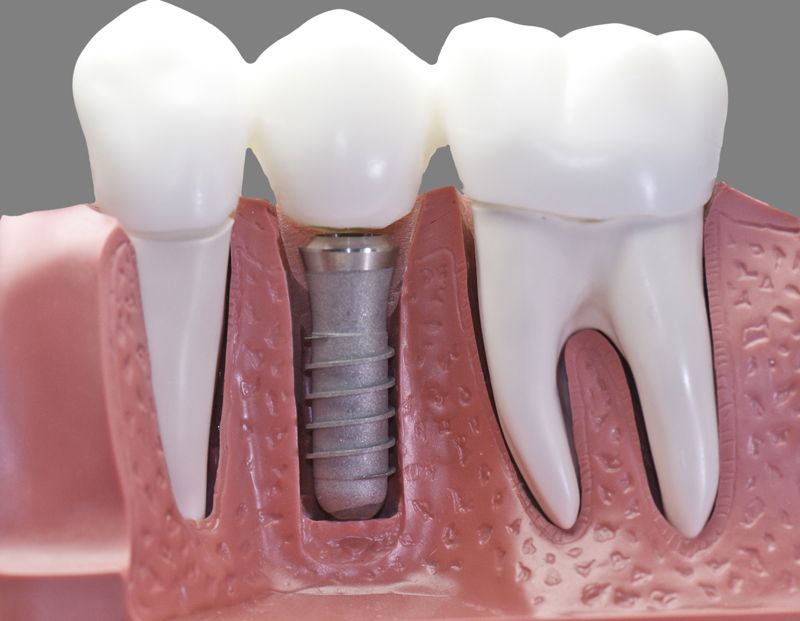
Treatment with dental implants is one of the latest advances in the science of dentistry. Implants are small titanium screws that replace the lost natural teeth. Implants placed inside the bone fuse with the bone during a certain healing period and support fixed or removable prostheses on them. In this way, many problems caused by classical prostheses are eliminated. By increasing the quality of life of the patient and the ability to eat and function normally.
The biggest advantage of implant treatment is the fact that no cutting process is performed on the neighboring natural tooth which is healthy. In patients who have lost some natural teeth but still have a certain number of natural teeth, fixed prostheses instead of pluggable prostheses have great advantages. In patients who lost all their teeth, either by using fixed porcelain prostheses, not having to use removable prostheses, or by using a few fewer implants and removing the removable prostheses, especially the lower jaw, is one of the great advantages provided to the patient.
What is the principle of service of implants?
Bone-implanted implants can fuse with the bone approximately 6-8 weeks later and carry the load of the prostheses. At the end of this period, it will be possible to start the construction of the implant prosthesis according to the implant system that your doctor deems suitable for you and to provide the function and esthetics at the desired level.
How many implants have been applied?
The first implants that have been placed and currently used by the patient have been in service for 35 years. Implant success, perhaps the longest and most controlled study of the science of dentistry, varies between 80 and 98% considering the various conditions and brands.
What are the requirements for implant placement?
Dental implants can be used to eliminate tooth deficiencies in all patients who have complete jaw growth and are in good general health. The basic requirements for implant application are the presence of adequate bone support, good oral care and a non-defective wound healing capacity. In order for implant surgery to be successful, it is necessary to treat natural teeth and eliminate gum discomfort if any. In addition, long-term success requires excellent oral care and tooth brushing.
Am I healthy enough to see implant therapy?
Generally speaking, patients who are healthy enough to undergo normal tooth extraction are considered healthy to undergo implant treatment. There are no people who cannot be implanted except those with very rare general health problems. This situation will be clarified after consultation with your dentist.
Furthermore, the structure of the jawbone and the amount of bone that can be implanted determine whether implant application can be performed. However, with the development of advanced surgical techniques, the patient who could not be implanted was almost absent.
Where and how is implant treatment done?
Before any treatment is offered a full consultation will be arranged with our physicians to discuss the options that will fit with your needs and provide the best advice available. During the consultation you will be informed how implant treatments work and describe how they will improve the quality of life for patients and aid eating and the visual improvement of your mouth. During the examination you will also be advised of your general health condition and might be asked to take some routine tests. The examination may also require an x-Ray using our latest technology 3D x-Ray machine and possible models of your mouth.
How to tell if there is enough support bone for implant treatment?
Clinical examination and x-ray preparations are tests that demonstrate whether there is enough bone. However, borderline cases may require computed tomography examinations that allow us to know the thickness of the jawbone in 3 dimensions.
I decided on implant treatment, but what are my alternatives if there is not enough bone tissue?
Today's surgical techniques and the materials we use have reached the levels that enable us to create bones in non-bone regions. Therefore, the absence of bone in the region is not as critical as it used to be.
What are the risks that can be observed during implantation?
The risks of implant application by properly planned and experienced physicians are no different from the risks that may be encountered during a tooth extraction. However, especially in the early period immediately after the operation, your physician's recommendations should be followed and oral care should be taken care of.
What are the prostheses on the implants?
Prostheses to be made on implants may be of different types depending on the nature of the case. In other words, they can be removed by the patient for easy cleaning, but can also be planned as fixed dentures which can be removed by the dentist. Both of them have different advantages compared to their own and the design that is suitable for you will tell you in detail before your treatment starts.
What advantages does implant therapy offer in case of toothlessness?
a) Patients who have lost their teeth and have a prosthesis in the lower jaw:
Both the smallest prosthesis and the presence of a moving organ, such as tongue, cause our patients to complain of prosthetic motion, prosthetic knock and good chewedness. In these patients, the application of implants abolishes all the above complaints and stops the melting of the bone.
b) Patients in the upper jaw who lose their teeth and wear a prosthesis:
Although the upper prostheses are less active, more conservative and more balanced than the lower jaw prostheses, the design of the prosthesis that has to close the palate can reduce the sense of taste and cause nausea. Implant treatment allows these problems to be eliminated.
c) Patients who have lost some of their teeth in the lower or upper jaw:
These patients may have a non-aesthetic appearance of the prosthesis (modern prosthesis) that has been caught by hooks, or the need to cut strong teeth to bridge. Implant treatment provides aesthetics and prevents damage to adjacent teeth.
d) Patients who lost one tooth:
These patients face the option of minimizing at least two adjacent teeth to fill a single tooth cavity. Even the slightest filling process on the tooth (no matter how careful it is done) has the risk of disturbing the tooth. The placement of a single implant eliminates the necessity to intervene in neighboring teeth and often leads to more aesthetic and functional outcomes.
What are the general advantages of dental implant treatment other than the above?
The most important advantage is that the prosthesis to be made on the implants, you feel like your own teeth, and do not restrict yourself during your daily operations such as talking and laughing chewing. Other benefits include:
In patients who lose their teeth and start to use prostheses, absolute bone resorption is seen as a biological rule. This may cause facial changes, profile depressions as the support of the cheek and lip will disappear after some time. However, because implants transmit a certain force on the bone, this prevents bone resorption and therefore facial changes.
· The chewing efficiency of people is reduced by approximately 4 times following tooth extraction. This is due to loss of chewing force receptors around the root of the tooth. Since implants will be placed inside the bone, it allows some of these recipients to re-enter and allow you to apply the chewing force as if you have natural teeth. The result is a more efficient milling process
· Another advantage is that the prostheses remain firmly in place. In this way, it is possible to know that the prostheses will not move and to laugh, eat and even kiss.
Because the bite force and prosthesis retention will be at the highest level, you can consume any kind of food without thinking that it will disturb you. This will ensure your balanced diet. Eliminating the limitations of your social life is also an added benefit.
Can implant treatment be performed at any age?
In general, healthy individuals between 18 and 99 years of age can benefit from implant treatment. In some special cases (where the bone development is found to be complete), people under 18 years of age may also be implanted. Lack of one or more teeth does not affect the chance of being treated. In addition, the patient's gender is not related to the success of implant treatment.
Is implant placement painful? How long will the surgical procedure take?
There is no pain during implant surgery under proper anesthesia. The pain felt after the operation is not different from a normal tooth extraction pain and can be easily avoided with the common painkillers. The use of painkillers and antibiotics may vary for each patient according to the conditions of the operation. Depending on the number of implants and bone status to be placed, the procedure can take from 30 minutes to 3 hours. However, according to your special situation, your physician will give you the most accurate information on this subject. A mild swelling after a few days of operation may be considered normal.
Will I have any discomfort during and after the operation?
The operation can be performed with local anesthesia and sedation without any pain or discomfort. There may be a slight pain or swelling that may be heard after any tooth extraction after the operation. They can also be relieved with pain relievers and necessary precautions.
Can I work after the operation?
Implant operations are a simple procedure that needs good after care and some rest. You might need to rest for a few days if more advanced surgical procedures are needed. Your physician will advise of the length of time that you need to rest dependant on your personal situation.
How long does it take for the prosthesis to be used after the implantation of the implants? How long can you stay without teeth?
After a detailed examination and treatment plan, the first stage of treatment is the placement of implants. After this procedure, it is recommended that no prosthesis should be inserted since it is not generally requested to transmit force to the area for about a week. A temporary prosthesis is then provided to the patient for 1.5-2 months with a bone that is filled with a material that will remain soft in the patient's existing prosthesis. In this way, the patient can continue social life as well as chewing process used.
The second stage of the treatment is to fit temporary prosthetics after 1-2 weeks. This will allow the implant to knit with the bone in the jaw. After two and a half months minimum the bone will have incorporated the implant and the new implant teeth can be made and fitted to the implant. On occasions bone reduction in the jaw will necessitate bone graft surgery which could lengthen this process. Your physician will explain this at the initial consultation.
Is it possible for the dental implants to be rejected by the body?
The incorporation of titanium implants with bone is formed by a very different mechanism than living organ transplantation. Therefore, there is no need for tissue mismatch, blood incompatibility or more specific tests. The concept of rejection of the implant is not scientifically correct. In other words, implants are not rejected. However, there may be a failure after implant placement. The most important reason for this is the small infections around the implant as a result of the patient not paying attention to the physician's recommendations. These infections, which do not cause any harm to the body, require only the placement of another implant, thus causing a loss of time. Titanium, which is used as an implant material, has never been observed to develop an allergic reaction. Failure of dental implants is negligible when appropriate conditions are met and correct procedures are performed. Summarizing the success criteria a) appropriate patient selection b) experience of the physician c) patient's importance to oral health and regular follow-up countable. If an implant fails, it is possible to re-implant the same area.
How long will the implants last?
Natural teeth are organs that need to serve for a lifetime. But if you look at the examples, you'll see that we have tooth losses throughout life.
Published scientific reports show that more than 80% of implants applied 30 years ago are still present in the mouth. However, it should be kept in mind that they are able to provide a very good oral cleansing after physician application. However, having your teeth and gum health checked regularly and eating healthy and smoking less will contribute positively to longevity.
The average life of standard prosthetic applications, whether a bridge or a modern prosthesis, is 7-12 years in the light of scientific data.
We all know that dental problems are caused by insufficient patient care or neglect. The same applies to implants. It is difficult to give a definitive answer to this problem due to reasons such as eating habits, hereditary condition, proper oral care, smoking habits beyond the control of the dentist. However, each physician aims to carry the patient's implant without any problems for a lifetime. Considering the recent advances in implant surfaces, implants are expected to serve in the mouth for life with proper care.
Do the implants require special care?
Our recommendation to patients who have dental implants is to accept them in the same way as natural teeth and apply the same care. These patients should come to regular follow-up and regular brushing. It requires regular personal care and professional control of our teeth. Implants require even more care, such as your own teeth. This is possible with regular brushing and interface cleaning. For this reason, the treatment of implants of individuals who cannot or do not have personal oral care mentioned above may cause some problems.
It is important to note that the most important factor for long-term success of this type of treatment is regular oral care. In addition, after the completion of the treatment of your doctor's directives you need to go to regular checks.
Is an implant required for every missing tooth? Or can the single implant carry the burden of more than one tooth?
An implant is not required for each tooth lost. Between 2 and 8 implants are required depending on the shape of the prosthesis to be made on a non-tooth palate and the amount and stiffness of the existing bone. If the number of missing teeth is more than 1, a single implant can serve 2 or 3 teeth depending on the area to be implanted.
Using a combination of natural teeth and implants, can the number of implants be reduced and the treatment cost can be reduced?
Although this situation is possible, it is not a preferred method unless it is necessary. This is because teeth and implants have different flexibility in the bone, and this may cause problems in the future. Therefore, this situation, which seems to be materially eco-economic in the short term, may be a method which may cause more costs and problems in the long term.
Can the time loss be prevented by placing the implants immediately after tooth removal?
This is an increasingly popular process, but to be successful, the following conditions must be met:
a) Sufficient bone at the site of attraction
b) The location of the attraction is completely free from inflammation
c) The absence of gingivitis in the teeth adjacent to the tooth taken
Is it true that the implants prevent the jawbone from reducing?
Yes. Implants, such as tooth roots, lead to the transmission of force to the bone to load a task to prevent bone resorption. Thus, there are no aesthetic problems that occur during the time after tooth loss.
I lost my teeth due to gingivitis. Can I still see implant therapy?
Yes. If you are going to take care of oral care, and do not interfere with the controls, you may see implant treatment.
I have a very allergic constitution. Dental implants do allergy?
Almost all of the implants used today are made of pure titanium. To date, there have been no cases of pure titanium-induced allergy in the world. Therefore, you can have implant treatment.
I lost a single tooth. My dentist offered to bridge the area to fill the void. However, I do not want to be damaged by shrinking my healthy teeth. Will implant treatment solve my problem?
Yes. Implant treatment is perfect for your condition. An implant that you lose will eliminate the risk of shrinking your two teeth adjacent to the site, thus eliminating the risk of future problems. In addition, such a single prosthesis will be easier to clean and maintain, and your gum health will be seriously protected.
Since I lost my teeth and started to use full dentures, I did not enjoy the food and I could not get the old pleasure from life. Can the implants help me?
Most likely yes. Since the implants will support the prostheses and will limit the movement of the prosthesis, the prosthesis will not need to be made too large or large, thus reducing the amount of tissue sealed by the prosthesis and returning to the sense of taste.
I've been toothless for a long time. Can I still see implant therapy?
You can benefit from implants treatments if you are a prosthesis wearer. The number of implants required will be decided dependant on the number of teeth on your prosthesis or number of teeth missing. Dependant on the physicians advice and you the patients wishes.
In which cases are classical bridge prostheses recommended instead of implants?
Until recently, most dentists recommended the application of classical bridges in the treatment of missing teeth. However, recent developments in the field of dental implantology have given us more treatment options. Nowadays, in some special cases where teeth adjacent to the cavity are in need of treatment, classical bridges with support from adjacent teeth can still be recommended. However, due to the failure of the integrity of the natural teeth, the non-alteration of the relationship with the opposing teeth, and many other technical limitations, many physicians have increasingly abandoned the bridge prosthesis application and are referring their patients to implant applications.

1969 Fethiye doğumlu Uzman Diş Hekimi Nuri Karaca, 1999 yılından beri kendi kliniğinde implant, diş beyazlatma, dolgu, diş restorasyonu, protez, kanal tedavisi ve diş eti hastalıkları tedavileri vermektedir.